
Meta Trend Online ShopPLAN BEAUTIFULLY, LIVE BRILLIANTLY
🛒 Cart
Sign In
Sign Up
The biggest crypto theft in history is really a story about trust. What happened, where things stand now, and the safety habits every online seller and buyer should copy.
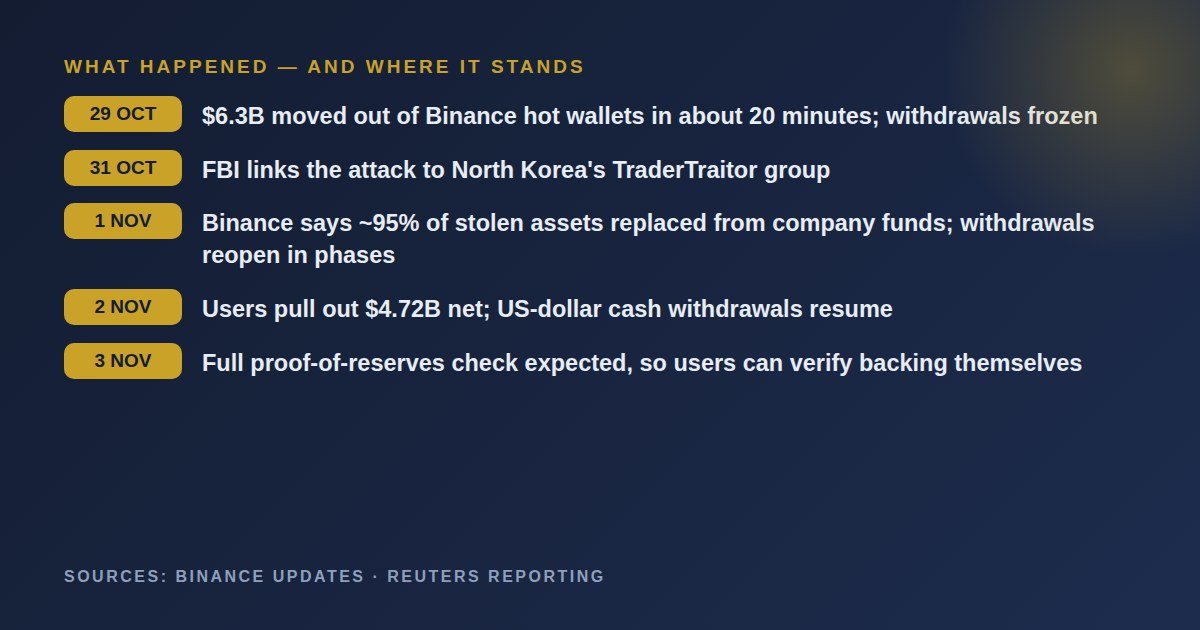
On 29 October 2026, about US$6.3 billion was moved out of Binance's hot wallets in roughly 20 minutes, across 10 blockchains — the largest theft in crypto history. Binance froze withdrawals within hours. Two days later, the FBI formally attributed the attack to TraderTraitor, the North Korean state hacking group also blamed for the $1.5 billion Bybit theft in 2025. Binance's own first findings pointed at something uncomfortably ordinary: a compromised laptop and malware — not broken cryptography.
That last detail is why this story belongs on a blog for online sellers. The vault was never picked. A login was.
Binance says it is covering the full loss from company funds — treasury, its insurance fund and security reserves — and that by 1 November about 95% of the stolen assets had been replaced, with user balances untouched. Withdrawals began reopening in phases on 1 November, starting with Bitcoin and the major stablecoins, and US-dollar cash withdrawals resumed on 2 November. Since the restart, customers have withdrawn a net $4.72 billion — around 3% of the platform's assets — which analysts read as confidence dented, but holding. A full proof-of-reserves check that lets users verify the backing themselves is expected on 3 November.
One warning that matters more than the timeline: after every big hack, a second wave follows — fake "compensation" messages asking people to connect a wallet or send money to "recover" funds. Binance has told users to trust only its official channels. That scam pattern is lesson zero, and it targets ordinary people, not exchanges.
Strip away the crypto and the shape of this event is familiar to anyone who sells online: a platform held other people's money, access was the weak point, and the whole business turned on one question — do users still trust it with their money tomorrow? Sellers felt the same freeze buyers did. Money you cannot withdraw might as well not be there, whether it sits on an exchange, a marketplace or a payment app.
That is exactly the thinking behind how we built MetaTrendOnline: sign-in is Google-only, so there is no shop password of ours to steal or reuse, and the first message every new seller receives tells them to switch on Google 2-Step Verification. A marketplace cannot control a seller's laptop — but it can refuse to be the weakest login in the chain.
1. Turn on 2-Step Verification everywhere money lives. The reported entry point in this hack was a person's device and access. A second verification step is the cheapest wall a thief can be made to climb — on your exchange, email, marketplace and bank accounts alike.
2. One account, one strong password. Most account takeovers start with a password reused from some older leak. A password manager makes "unique everywhere" effortless instead of impossible.
3. After hack news, trust nobody who messages you. Real platforms do not ask you to send money, share codes or connect wallets to "verify" compensation. Go to the official app or site yourself — never through a link in a message.
4. Never keep all your money in one place. Withdrawals froze for about two days. Sellers who had earnings spread across a wallet, a bank account and a second platform kept operating; everyone else waited. Treat any single balance as money you can afford to see paused.
5. Check the reserves before you need them. Binance could absorb a $6.3 billion hole because it had a treasury, an insurance fund and reserves — and it is now publishing proof of reserves so users can verify instead of trust. Ask the same question of any platform that holds your earnings: what stands behind my balance?
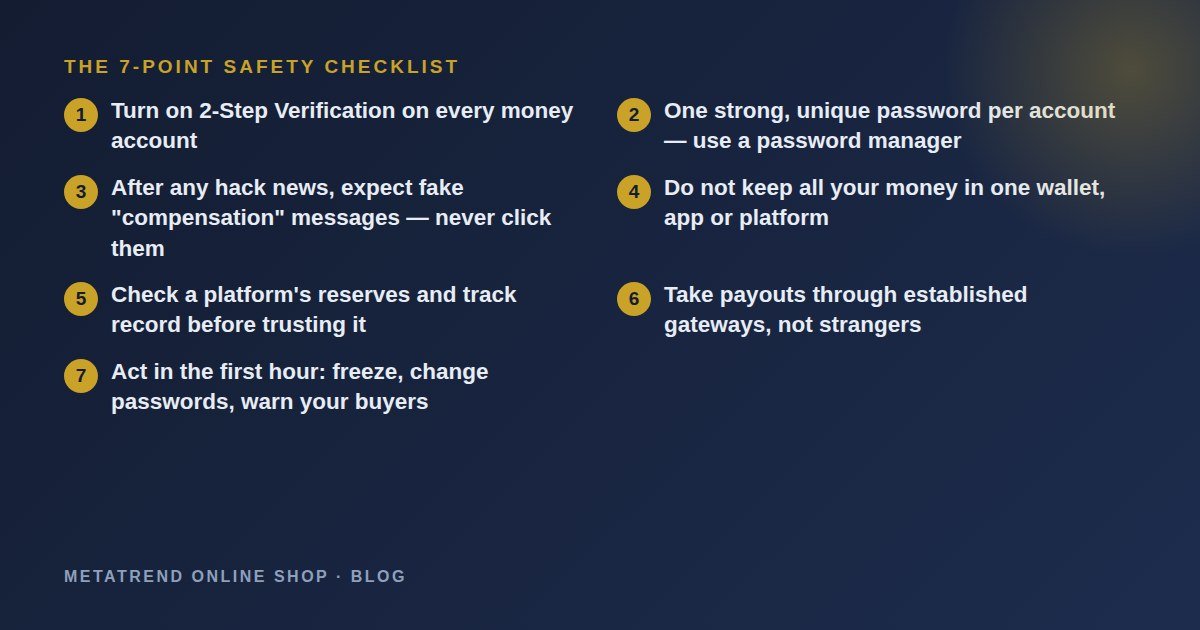
6. Take payouts through established gateways. A regulated, named payment route leaves a trail and gives you someone to call. "Send it to this personal account, it is faster" is how sellers lose both the money and the proof it ever existed.
7. Have a first-hour plan. If a platform you use is ever breached: freeze what you can, change the password from a clean device, turn on 2-Step Verification, and tell your buyers yourself before rumours do. Speed and honesty are what turned Binance's worst week into a story about recovery instead of collapse.
Binance says no — the stolen funds came from company hot wallets, the loss is being covered from company funds, and about 95% had been replaced by 1 November, with balances of the major coins stated as 100% backed.
Partly. Withdrawals reopened in phases from 1 November — major coins and networks first, US-dollar cash withdrawals on 2 November — with more assets being restored as security checks complete. Expect some delays while traffic is heavy.
Because the method, not the platform, is the story: a compromised device and login, followed by fake compensation messages. Those two moves are used against marketplace sellers, freelancers and wallet users every week — the checklist above is written for them.
Only through a proper gateway that handles conversion and records, and only as one option among several — never as the only way your money can reach you. Lesson 4 applies to payment methods too.
The biggest theft in crypto history was not a failure of mathematics; it was a failure of access — and the platforms and sellers who survive events like this are the ones who treated logins, reserves and payout routes as seriously as sales. Do the seven steps once, and a headline like this becomes something you read about, not something that happens to you.
This article is a safety guide, not financial advice.

Selling to buyers abroad is the easy part — getting the money into your hands in Pakistan is where most new sellers get stuck.

Every route a Pakistani seller can actually use to receive money, with fees and timings side by side.

The two wallets every Pakistani seller knows, compared on the numbers that decide which one your money should travel through.