
Meta Trend Online ShopPLAN BEAUTIFULLY, LIVE BRILLIANTLY
🛒 Cart
Sign In
Sign Up
Fridges warming to 50 degrees across Europe is not just a supermarket story. It is a warning about default passwords, old software and internet-exposed logins — the same weaknesses that put any online seller at risk.
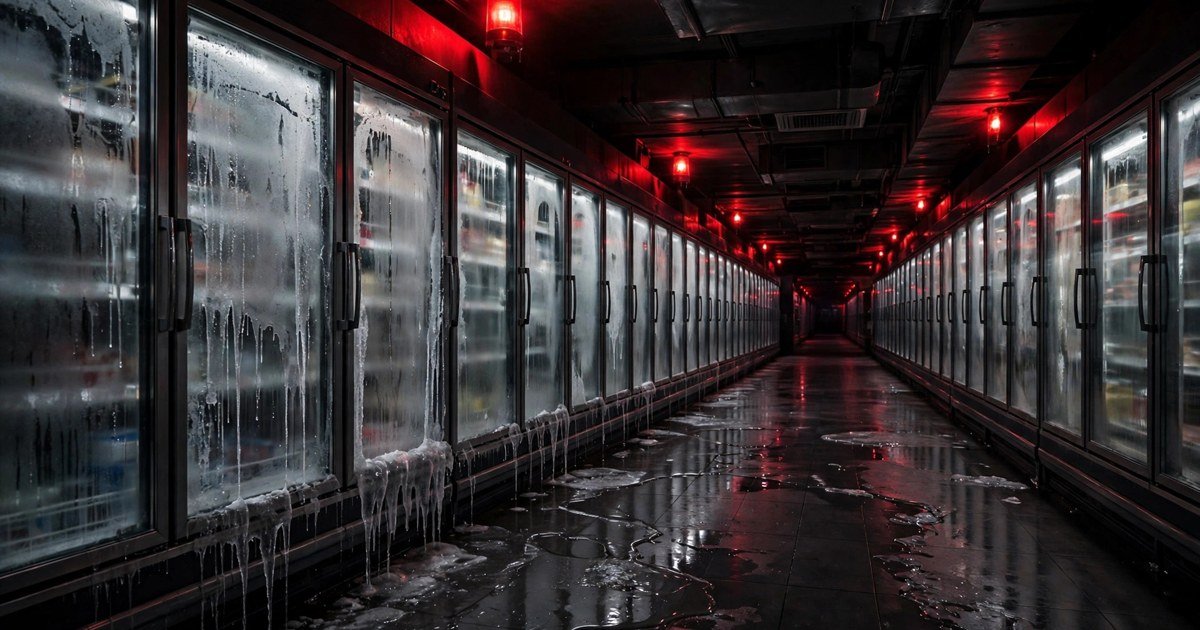
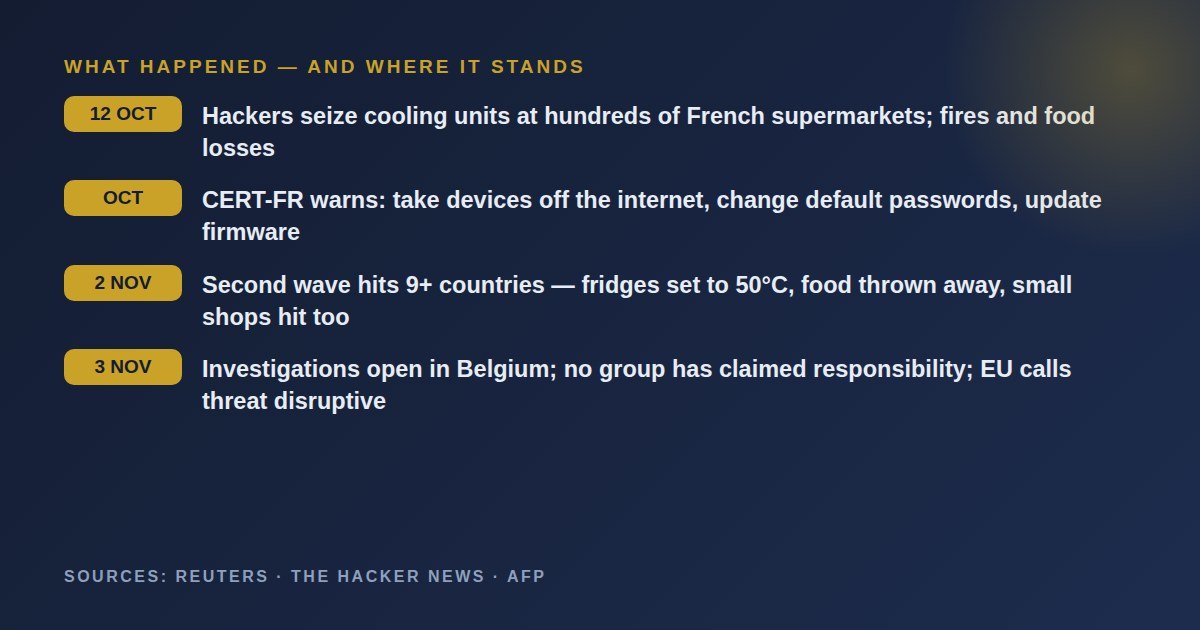
Overnight into Monday, 2 November 2026, attackers remotely changed refrigeration controls at supermarkets across Europe — Belgium, Sweden, Estonia, Ireland, the Netherlands, Finland, Portugal, Italy and Luxembourg. In several stores the setting was pushed to 50°C. Staff arrived to warm fridges and freezers, and chilled and frozen food had to be thrown away.
It was the second such wave in three weeks: on 12 October, hackers seized cooling units at hundreds of French supermarkets, in some cases causing fires and food losses. This week's attack echoed it — same kind of equipment, same method, again no group claiming responsibility by Monday night. Belgium's federal prosecutor has opened a criminal investigation, and the European Commission said the incidents showed how digital threats are becoming increasingly disruptive.
The human scale sits in the small print: at a butcher shop in Hove, near Antwerp, fridges were turned up to 18°C, ruining about €15,000 worth of meat. Delhaize reported several dozen affected stores in Belgium, Carrefour 15 of 700-plus, Intermarché 10 to 15; Sweden's Coop 6 to 7 of 800, Ireland's Musgrave 13 of 223. In Estonia, one Selver freezer set to 50°C rose only 2–3°C before staff fixed it in 10 minutes, with no products damaged.
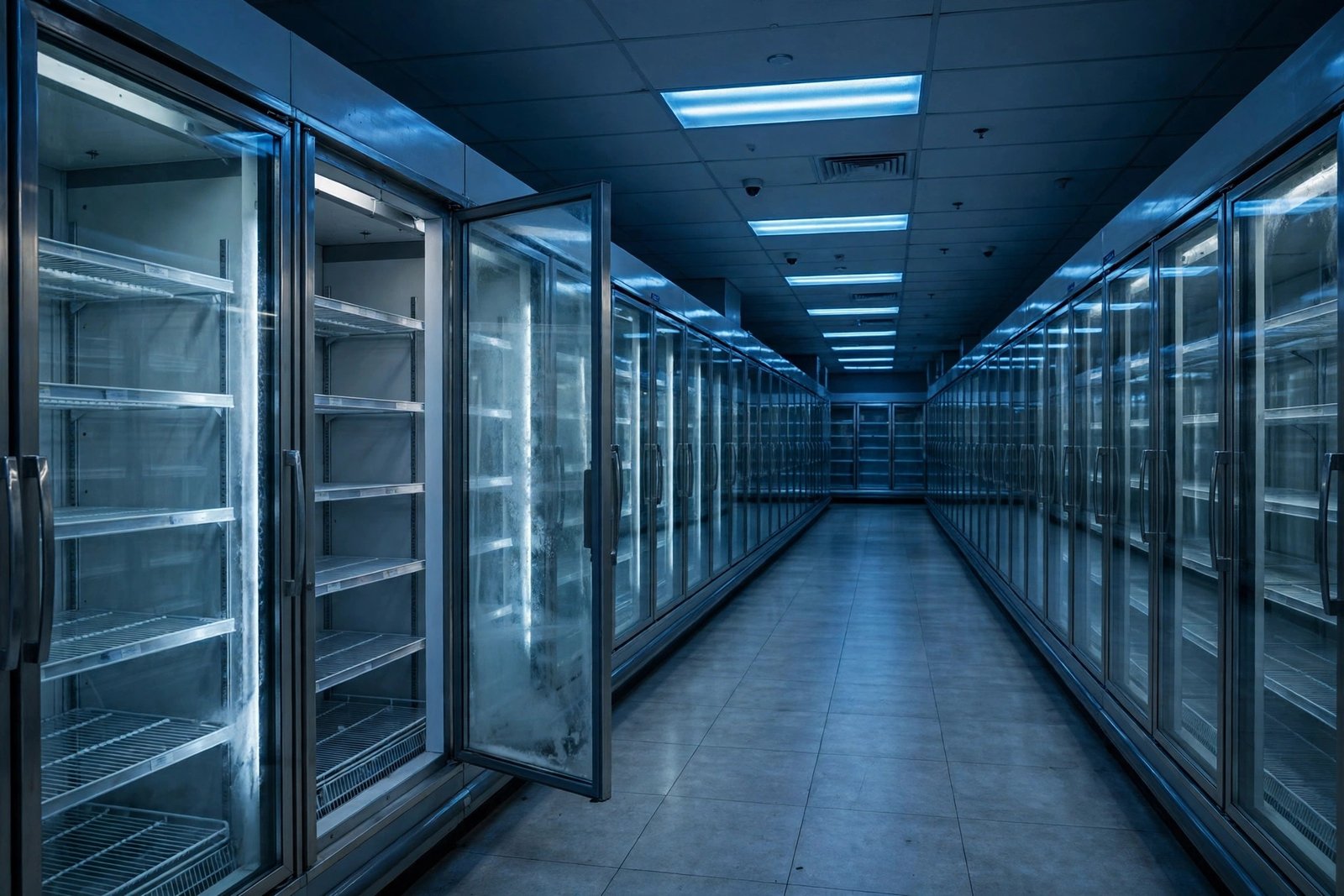
The fridges were not broken into. Their controls are computers, connected to the internet for remote monitoring and repair. That connection was the way in. In the Netherlands, Danfoss told broadcaster NOS the systems hit were not on a secure network and still used default passwords. Several of the units hit were older Danfoss models that no longer receive security updates. In Estonia, the one Selver store that was hit was the last the chain had not yet moved to a new system. In Belgium, contractor Sabcobel said attackers got into individual supermarkets' own systems, and that many — but not all — stores had secured their connections after the French attack.
France's cybersecurity agency, CERT-FR, had warned operators in October: keep such devices off the internet, restore access only through a secure VPN, set security to Strict, change default passwords, and update firmware. End-of-life devices left online, it warned, are very likely to be compromised. The second wave suggests the warning had not reached everyone yet — and the ones it missed were exactly the ones hit.
Nothing in that list is specific to fridges. A seller's shop admin, email inbox, payment app and social accounts are the same: systems reachable from the internet, protected — or not — by a password, a login and an update schedule. The attackers did not need to beat the defences. They needed the defences to be the factory defaults.
The Dutch cases carry the warning small sellers most need to hear: the victims were not only supermarket giants — at least 17 businesses in the Netherlands were hit, including butchers and small local shops. "Too small to be a target" is not a defence; it is why smaller setups get picked.
That is the thinking behind how we built MetaTrendOnline: sign-in is Google-only, so there is no separate shop password to steal or reuse, and every new seller's first message tells them to switch on Google 2-Step Verification. A platform cannot control a seller's devices — but it can refuse to be the weakest login in the chain.
1. Change every default password — today. Router, shop admin, apps, any connected device. A shipped-with password is public knowledge, and attackers check it first.
2. Do not leave admin panels open to the internet. If a tool need not be reachable from anywhere in the world, do not let it be. Give suppliers a secure, private connection — and switch it off when the job is done.
3. Update the software, especially the old stuff. The units hit in both waves were disproportionately the ones never updated. A postponed update is the exact door attackers try first.
4. Turn on 2-Step Verification wherever money or customer data lives. Email first, then marketplace, bank and wallet accounts. One stolen password should never be enough.
5. One account, one strong password. Most takeovers start with a password reused from an older leak. A password manager makes "unique everywhere" a default.
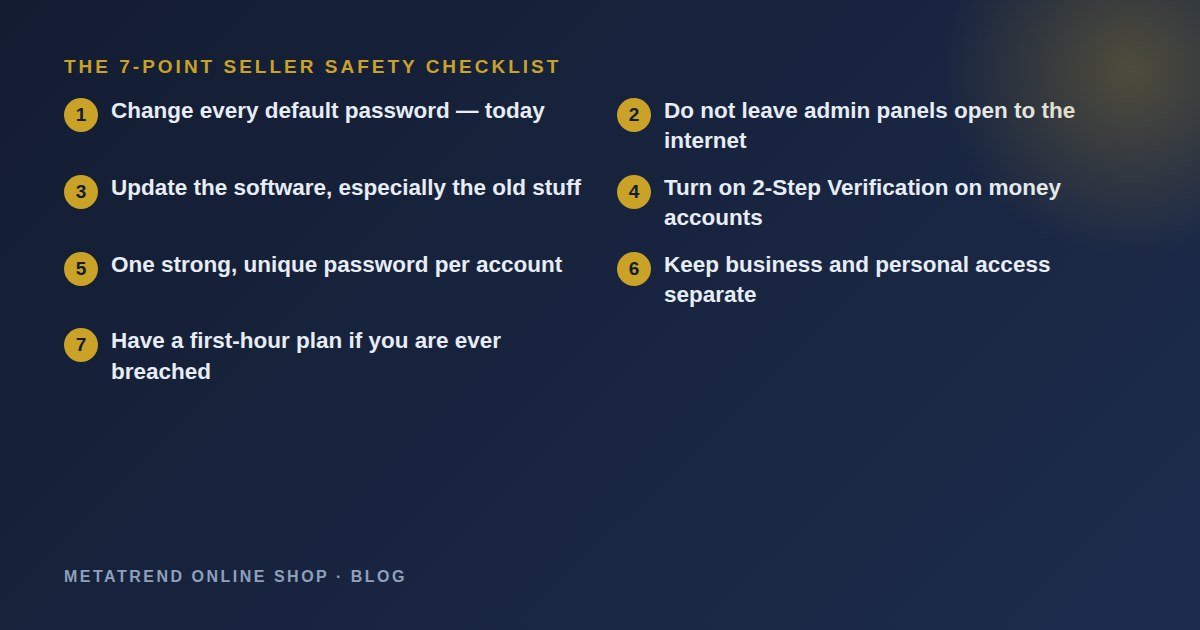
6. Keep business and personal access separate. A personal inbox that can reset your shop password is a shop password. Limit who can change payout details.
7. Have a first-hour plan. If an account or device you use is ever breached: freeze what you can, change the password from a clean device, switch on 2-Step Verification, and tell your customers yourself before rumours do. The chains that recovered fastest said so on day one.
No — it targeted refrigeration controllers, not shops or marketplaces. But the method is used against shop admins, routers and accounts: an internet-exposed login, a default password, and software nobody updated.
It is the password a device or service ships with, often printed in its manual or on a sticker. If you never changed it, change it now to something unique, and never reuse it.
The Dutch small shops hit this week say yes. The steps take under an hour once, and most then look after themselves.
Do not click its links or share codes. Go to the official app or site yourself. Real platforms never ask you to send money or codes to "verify" anything.
The freezers were not hacked because refrigeration is hard to secure; they were hacked because the basics — passwords, updates, private access — had been skipped. Treat those basics as seriously as sales, and a headline like this becomes something you read about, not something that happens to you.
Reuters, "New cyberattack on supermarket fridges sweeps across Europe", 2 November 2026 — spread, store counts, 50°C settings, the Hove butcher's €15,000 loss, Belgian investigation.
The Hacker News, "New Wave of Refrigeration Cyberattacks Hits Supermarkets Across Europe, Forcing Stores to Pull Food", 3 November 2026 — company table, Danfoss and Sabcobel statements, CERT-FR guidance.
AFP reporting, 2 November 2026 (via Khaleej Times and Kuwait Times) — 2 a.m. timing, Dutch small shops, EU Commission comment.
In-body pictures are representative illustrations, not photographs of the incidents. This article is a safety guide, not professional security advice.

Selling to buyers abroad is the easy part — getting the money into your hands in Pakistan is where most new sellers get stuck.

Every route a Pakistani seller can actually use to receive money, with fees and timings side by side.

The two wallets every Pakistani seller knows, compared on the numbers that decide which one your money should travel through.