The question every creator asks first
If you already post on Instagram, you already have the hardest part of selling: people who watch what you make. So why would you need a store at all — and if you open one, does Instagram become a waste of time? The honest answer is that neither side replaces the other. Instagram is where strangers become followers; a store is where followers become buyers, and buyers become repeat customers. The creators who do best use both, each for the job it actually does well.
This comparison is for a Pakistani creator starting from scratch: a small Instagram account, and a digital product — a planner, a template, a printable — that is ready or nearly ready.
What Instagram does brilliantly
Instagram is built for discovery. A reel can reach people who have never heard of you, and a carousel can explain a product in five swipes. You can test an idea in public before perfecting it: post a planner page, watch which design people save and share, and you learn what to make next.
Instagram also builds trust faster than a cold product page. When people have watched you explain a budget sheet and answer questions in the comments, they are far more likely to believe the file is real and useful.
And for a first sale, Instagram feels easy: you post, someone messages you, they pay, you send the file. No setup, no listing form. That ease is real — and it is why many creators stay there long after it has stopped serving them.
Where Instagram alone starts to break down
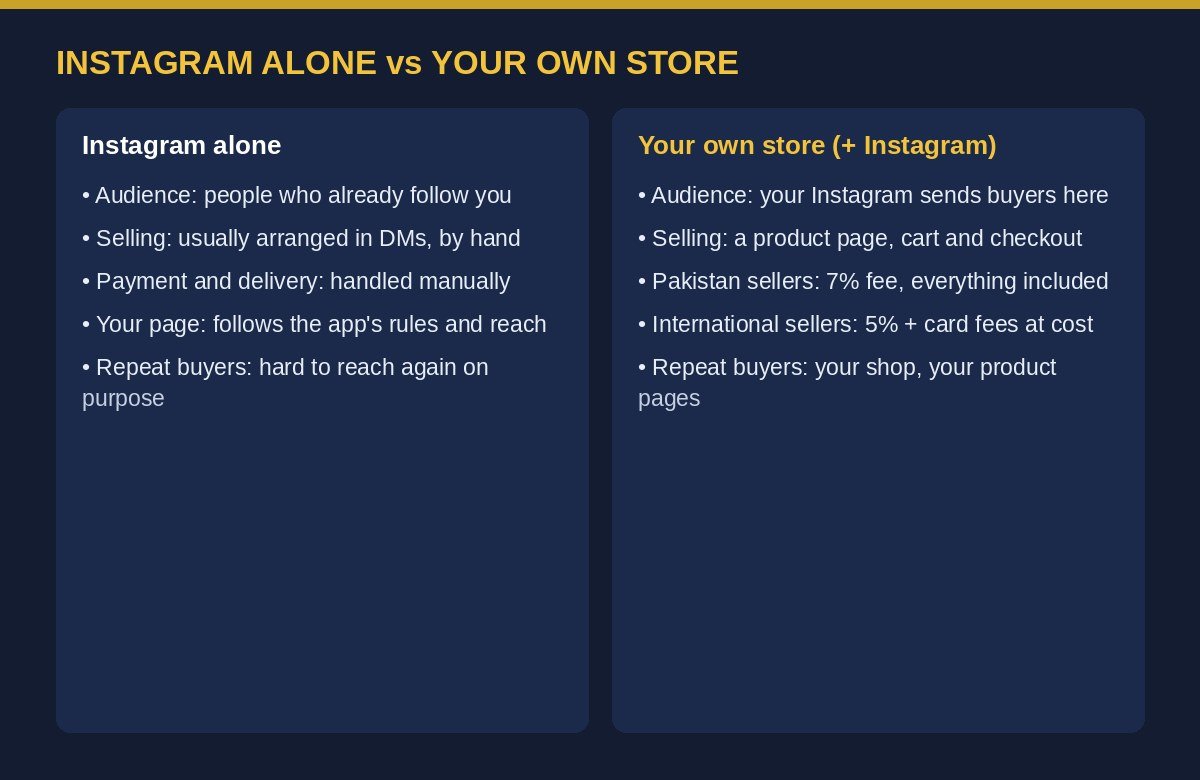
The problems appear not with the first sale, but with the tenth and the fiftieth. Selling in direct messages means every sale is a conversation — price, payment, delivery, follow-up — handled by hand, one buyer at a time. Manageable for five buyers a week; a second job at fifty, and impossible while you are asleep or at work.
Then there is the finding problem. Instagram is a feed, not a catalogue. A buyer who saw your planner three weeks ago must scroll back and hope the post is still findable. There is no product page listing what is included, what format it comes in, and what it costs. Every question a buyer must ask in a message is a sale that might not happen.
Finally, your audience on Instagram lives on someone else's platform. The rules, the reach and the layout can change without asking you, and a buyer list you cannot contact outside the app is not really yours. None of this makes Instagram bad — it makes it a rented room, not a shop of your own.
What your own store adds
A store gives each product a permanent home: one page, one price, one description, one buy button. A buyer can find it from your bio link today or a search next month, read exactly what they are getting, pay, and download — without waiting for you to reply. That matters most for digital products, whose whole point is selling while you do something else.
A store also lets buyers browse. Someone who came for a budget planner can see your other products and buy a second file without a second conversation — on Instagram, that second sale needs another post and another message thread.
And a store keeps the relationship in one place: orders, product pages and your shop name together, so a happy buyer knows where to come back.
The honest fee comparison
Posting on Instagram costs nothing, and that is a genuine advantage at the start. But free posting is not free selling: every DM sale costs your time, and your time is the one thing a growing creator runs out of first. A store charges a fee, and in return it does the repetitive work — the product page, the checkout, the delivery, the order record — for every sale, whether you are online or not.
Here, the fees are written down in plain terms, so you can judge them yourself. Sellers from Pakistan pay a single 7% fee that already includes payment costs: sell for Rs 1,000 and Rs 930 is yours, paid out every Monday to JazzCash, Easypaisa or your bank once you pass Rs 1,000. International sellers pay a 5% service fee, with card processing at cost, and payouts monthly in the first week, from $25, through Payoneer. Registration is $5 for international sellers and Rs 500 for Pakistan sellers — and the first 200 Pakistan places and first 100 International places are free. There is no per-listing fee here, which matters when you are testing several products at once. If you are weighing a big marketplace instead, we worked through those stacked fees in our guide Etsy vs Your Own Online Store.
The fair comparison is not "free versus 7%" — it is "your hours versus 7%". If ten DM sales a week already eat your evenings, the fee buys your time back. If you sell two files a month to friends, Instagram alone is the right call for now.
The setup that uses both
You do not have to choose. This simple setup keeps Instagram at the centre of your marketing while the store handles the selling:
- Keep posting where people already are. Show the product in use and answer real questions. That is Instagram's job, and it does it better than any store page.
- Put one store link in your bio, and point every post at it. Not a different payment link per product, not "DM for price" — one link to a page where the price and buy button are already there.
- Give each product its own page. When someone asks about a planner in the comments, reply with the link to that planner's page, not just to your shop's front door. One extra click is often one lost sale.
- Answer DMs with the link, not a price negotiation. A short reply with the product page link is faster for you and clearer for the buyer than a ten-message thread.
- Let the store do the night shift. While you are offline, the product page still answers questions and the checkout still works — the part Instagram alone can never give you.
If you are still building your first product, our beginner's guide How to Sell Digital Products from Pakistan walks through choosing, pricing and listing it, and our payout guide explains exactly how Pakistani sellers get paid.
So, where should you start?
Start on Instagram alone if you are still testing ideas and sell only a handful of files a month. At that stage, the personal touch is a strength, not a bottleneck.
Open your store as well if answering DMs is eating your evenings, buyers keep asking the same price and format questions, or you want sales while you are offline. That is where a product page and checkout stop being a luxury and start letting you grow.
Most creators cross that line sooner than they expect — often at their tenth sale, not their hundredth. When you do, keep posting exactly as before. Just stop selling in the comments, and let the link do the selling for you.